The AI Velocity Illusion: Why Copilots Stall at the Workflow Boundary
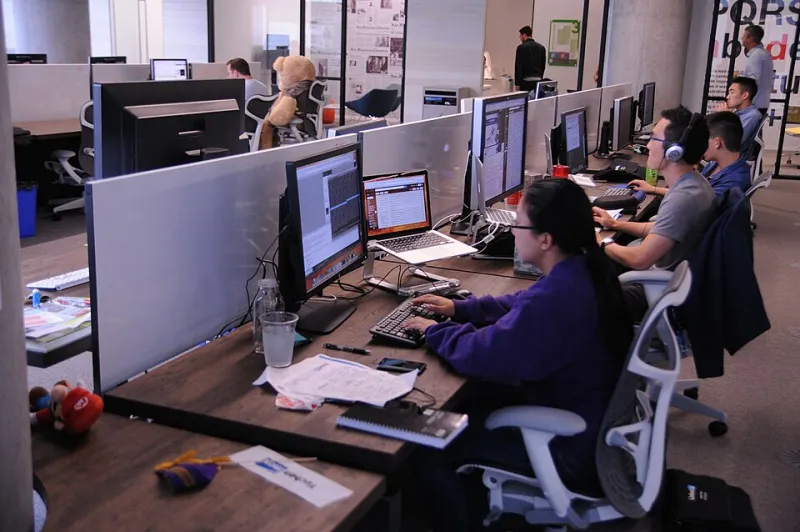
Photo: Sylvain Kalache from San Francisco, USA, CC BY 2.0, via Wikimedia Commons
US enterprises have moved quickly to put AI copilots in front of engineers, analysts, and product teams. The logic is appealing: if a tool can draft code, summarize requirements, or propose a test, then the organization should move faster. Yet many programs discover a familiar pattern after the pilot. Individual tasks get quicker, but delivery does not. The queue simply migrates from writing to reviewing, from building to validating, from doing to approving.
That migration is the subject of this analysis. The constraint in most AI rollouts is not model capability. It is the workflow layer around the model: the review cycles, handoffs, quality gates, and approval paths that were designed for a pre-copilot pace. When those remain untouched, AI compresses one stage and exposes the next. The result is an illusion of velocity.
Local Speed, System Stall
A coding assistant can reduce the time required to produce a first draft. It can also increase the volume of code, tests, and documentation entering the review queue. If review capacity is fixed, the queue grows. If reviewers are already a bottleneck, the organization may end up with more work in progress and no improvement in lead time.
The same pattern appears outside engineering. AI-generated campaign copy can accelerate drafting while creating more brand, legal, and compliance review requests. AI-generated customer summaries can speed case handling while increasing the need for verification. In each case, the tool improves a local task and places additional pressure on a downstream control.
This is not an argument against copilots. It is an argument against treating deployment as the finish line. AI becomes strategically useful only when the organization redesigns the work around it.
Where AI Gains Evaporate
Leaders can find the workflow layer by asking where work waits. A practical diagnostic starts with five questions.
- Which stage has the longest queue time, not the longest touch time? AI often reduces touch time while leaving queue time unchanged.
- Which reviews exist because of past defects, and which exist because of habit? Some controls are essential; others are inherited ceremony.
- What happens to AI-generated output after first review? If rework rates rise, the organization is paying for speed with correction effort.
- Which approvals are risk-based, and which are uniform? A low-risk content change and a high-risk model change should not follow the same path.
- Where does work wait for a person who is also reviewing AI output? Reviewer attention is a finite resource and should be managed as capacity.
These questions expose a simple truth: an AI program that ignores the workflow layer tends to optimize the wrong metric. It celebrates time saved in creation while missing time lost in coordination.
A Measurement Model That Separates Activity From Outcome
A useful measurement model should compare the flow of work before and after AI adoption, not just tool usage. Four categories are enough to begin.
Flow. Track lead time, queue time by stage, work in progress, and handoff latency. The key question is whether work moves through the system faster, not whether individual contributors type faster.
Quality. Track rework, escaped defects, review findings, and rollback rates. If AI increases output but also increases correction, the net gain may be negative.
Risk. Track review coverage, security findings, and approval exceptions. Faster delivery is not progress if it depends on bypassing controls.
Economics. Track cost per completed change, reviewer hours per release, and the cost of delayed decisions. AI has an operating cost; the business case should include the cost of the surrounding workflow.
A simple rule helps executives interpret the results. If the only metric that improves is creation speed, the organization has an activity gain, not an outcome gain. If lead time, quality, and risk remain stable or improve together, AI is changing the system rather than decorating it.
Redesign Before Rollout
The most effective AI programs redesign a few workflow points before scaling the tool. They move from serial review to paired review where appropriate. They use automated checks to clear low-risk changes and reserve human attention for judgment. They reduce batch size so AI-generated work is reviewed in smaller increments. They define risk tiers for approvals instead of applying the same gate to every change.
None of this requires abandoning governance. It requires calibrating governance to risk. The goal is not to remove controls but to place them where they prevent real harm and to automate the evidence that controls generate.
At Samvruddhi Developers, the lesson we see across transformation programs is consistent: AI amplifies the design of the organization it enters. In a well-designed workflow, it compounds speed and learning. In a fragmented workflow, it compounds queues, rework, and ambiguity.
The Leadership Test
Before expanding a copilot program, leaders should ask a blunt question: if the tool disappeared tomorrow, would our delivery system be better designed because of how we integrated it? If the answer is no, the organization has bought a tool, not a strategy. The next phase should focus on the workflow boundary, where the real return on AI is won or lost.